Static mixers: balancing mixing quality and pressure drop with CFD
When correlations don't match reality, simulation can expose the trade space and prevent costly oversizing.
Updated: 2026-01-02 · ~5 min read
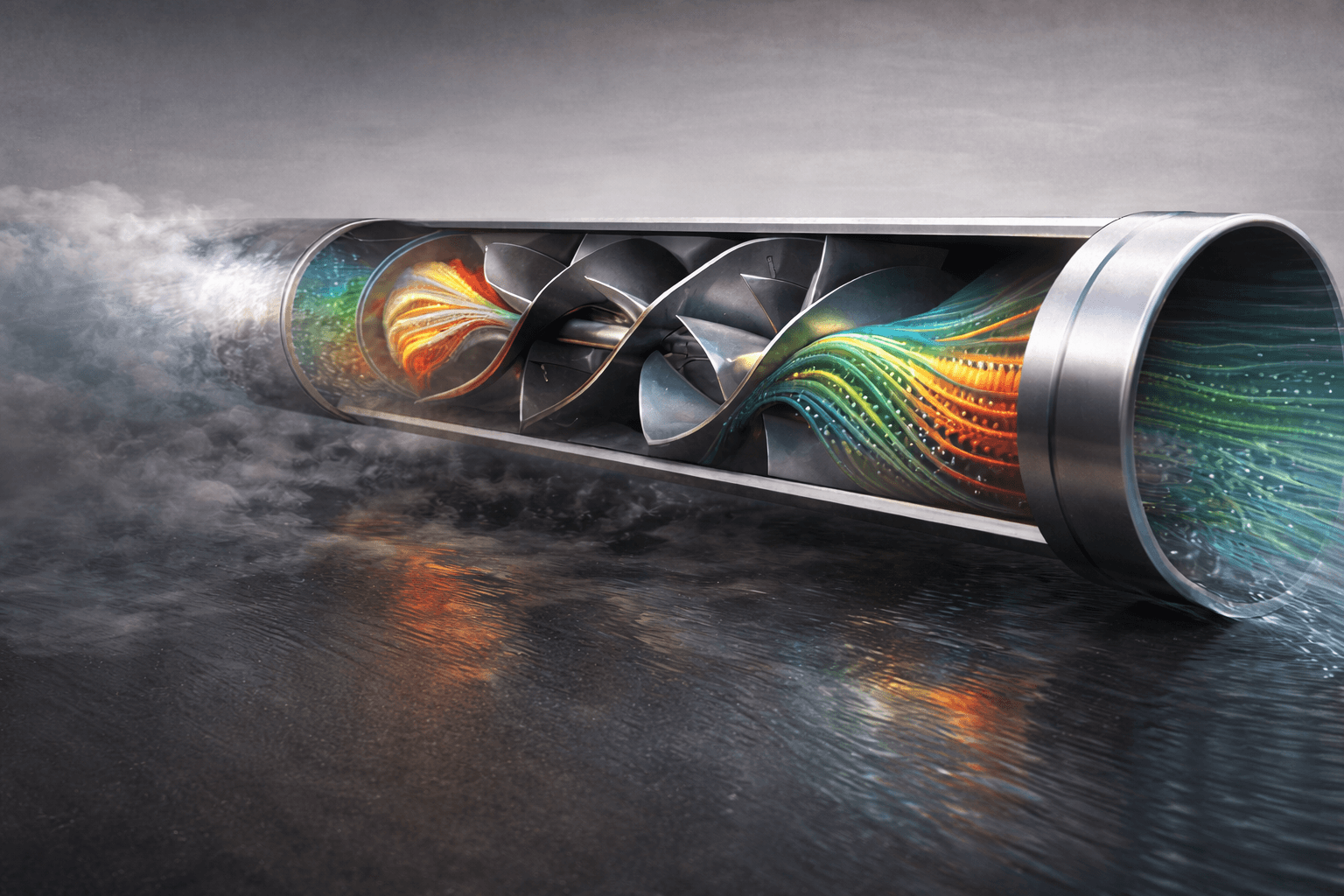
The situation
Static mixers sit right at the intersection of performance and cost: you want uniformity, but you can't afford excessive delta-P. Many teams rely on correlations or vendor curves that don't reflect their exact geometry, viscosity regime, or multiphase behavior.
Why it matters
Without defensible performance understanding, teams risk:
- Energy penalties (higher pumping costs)
- Underspecified mixing (quality defects, batch variability)
- Disputes about "guaranteed" performance
- Late redesign when the system is already built
What analysis changes
A focused simulation study can help answer decision-level questions such as:
- The delta-P vs. mixing trade curve for your specific conditions
- Where losses occur and which elements drive them
- Sensitivity to flow rate, viscosity, and phase fraction
- Whether small geometry changes create disproportionate gains
Typical approach
- Define the decision: sizing, element selection, or a redesign change.
- Build a bounded simulation model (RANS/LES as justified; scalar mixing metrics where appropriate).
- Sweep a minimal set of operating points to map sensitivities.
- Deliver the trade space clearly: what you gain per unit delta-P and where the "knee" is.
Deliverables
- Delta-P curves across operating ranges
- Mixing effectiveness metrics (distribution, scalar uniformity, dead zones)
- Geometry/element recommendations with rationale
- Assumptions/limitations documented for sign-off
Common pitfalls
- Running too many cases without a decision framework
- Reporting only averages (missing maldistribution and dead zones)
- Comparing to correlations without explaining why they diverge
Learn more about what we help resolve and how engagements work.
FAQ
Can you do this without full CAD?
Often yes—if the mixer type and key dimensions are known, an early bounding model is possible.
Do we need multiphase modeling?
Only if phases materially affect mixing or pressure losses for the decision at hand.
What's the typical output that helps teams move?
A clear trade curve and a recommendation tied to the decision.
Tags: